Author Archives: Michael Moore

February 2026

Welcome!

Welcome to the February 2026 edition of the NCEO newsletter! In this issue we highlight a timely past product, two new resources, and a popular section of our website. 

The first new resource shared is NCEO’s 17th Survey of States. For over 30 years, NCEO has surveyed state special education and assessment directors to identify trends and issues in statewide assessment of students with disabilities. Our other highly anticipated new resource is the proceedings from the NCEO forum held at the National Conference on Student Assessment (NCSA) in June 2025 on Assistive Technology, Alternate and Augmentative Communication, and Artificial Intelligence. 

Also, as states enter testing season, we wanted to share a popular brief from our School Leader Series that provides quick access to information on what school leaders need to do before, during, and after the assessment window. 

Finally, we are excited to feature our State Policies Webpage, your centralized hub for quickly locating state assessment manuals and other state accessibility information.

Kristi Liu and Andrew Hinkle – NCEO Co-Directors

New Resources 

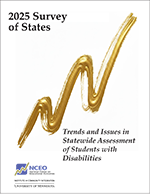
2025 Survey of States: Trends and Issues in Statewide Assessment of Students with Disabilities

How does your state’s approach to including students with disabilities in state summative assessments and annual English proficiency assessments compare to national trends? The report, 2025 Survey of States: Trends and Issues in Statewide Assessment of Students with Disabilities, summarizes survey findings from state special education and assessment directors in 45 regular and unique states.

Read entire article


At a Crossroads: The Intersection of AT, AAC, and AI in the Education of Learners with Varied Needs
How can state education agencies balance the convergence of assistive technology (AT), augmentative and alternative communication (AAC), and artificial intelligence (AI) while maintaining valid assessments? On June 25, 2025, nearly 40 participants from state agencies, assessment vendors, and educational organizations gathered for the annual NCEO Forum held after the National Conference on Student Assessment (NCSA). The report, At a Crossroads: The Intersection of AT, AAC, and AI in the Education of Learners with Varied Needs, captures the proceedings.

Read entire article


In Case You Missed It

What School Leaders Need to Do Before, During, and After the Assessment Window
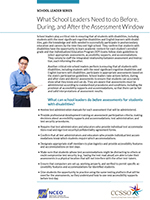
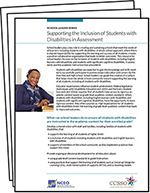
During state assessment season, school leaders face a busy period of coordination and oversight. The School Leader Series Brief #4: What School Leaders Need to do Before, During, and After the Assessment Window is an essential guide for managing the many moving parts of this process. This resource, created with input from state experts, provides school leaders with a clear plan to ensure that students with disabilities take the appropriate state assessments with allowable, appropriate accessibility features and accommodations.

Read entire article


Find State Assessment Policies Quickly
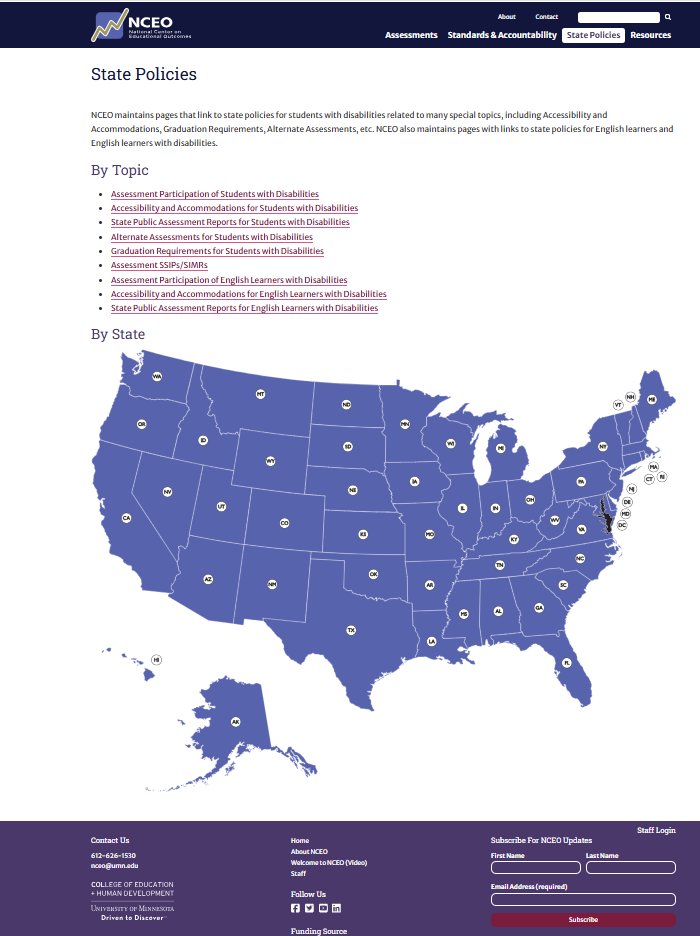
Finding the assessment policies and accommodations manuals for state testing can often feel like a digital scavenger hunt. To simplify this process, NCEO maintains a centralized hub designed to help you quickly locate state assessment policy information. Whether you are looking for specific accommodations for an IEP meeting or researching assessment policies across the country, NCEO’s State Policies Webpage is the place to start.

Read entire article


The Center is supported through a Cooperative Agreement (#H326G210002) with the Research to Practice Division, Office of Special Education Programs, U.S. Department of Education. The Center is affiliated with the Institute on Community Integration at the College of Education and Human Development, University of Minnesota. Consistent with EDGAR §75.62, the contents of this report were developed under the Cooperative Agreement from the U.S. Department of Education, but do not necessarily represent the policy or opinions of the U.S. Department of Education or Offices within it. Readers should not assume endorsement by the federal government.

Project Officer: Kristen Rhoads

ICI and UMN logos

October 2025

Greetings!

Fall is a time of fresh starts, and we’re excited to share this fall issue of our newsletter with you. We are especially proud of the work highlighted here and the forward momentum it represents. This issue features key updates that reflect the theme of renewal. These updates touch on our 35 years of history, our commitment to innovation, and our future partnerships.

First, in our article “35 Years of Impact,” we reflect on our journey as NCEO proudly marks 35 years as a national leader in assessment and outcomes for students with disabilities. The article also points to our new NCEO history page, documenting our impact on federal and state policy and legislation over the years.

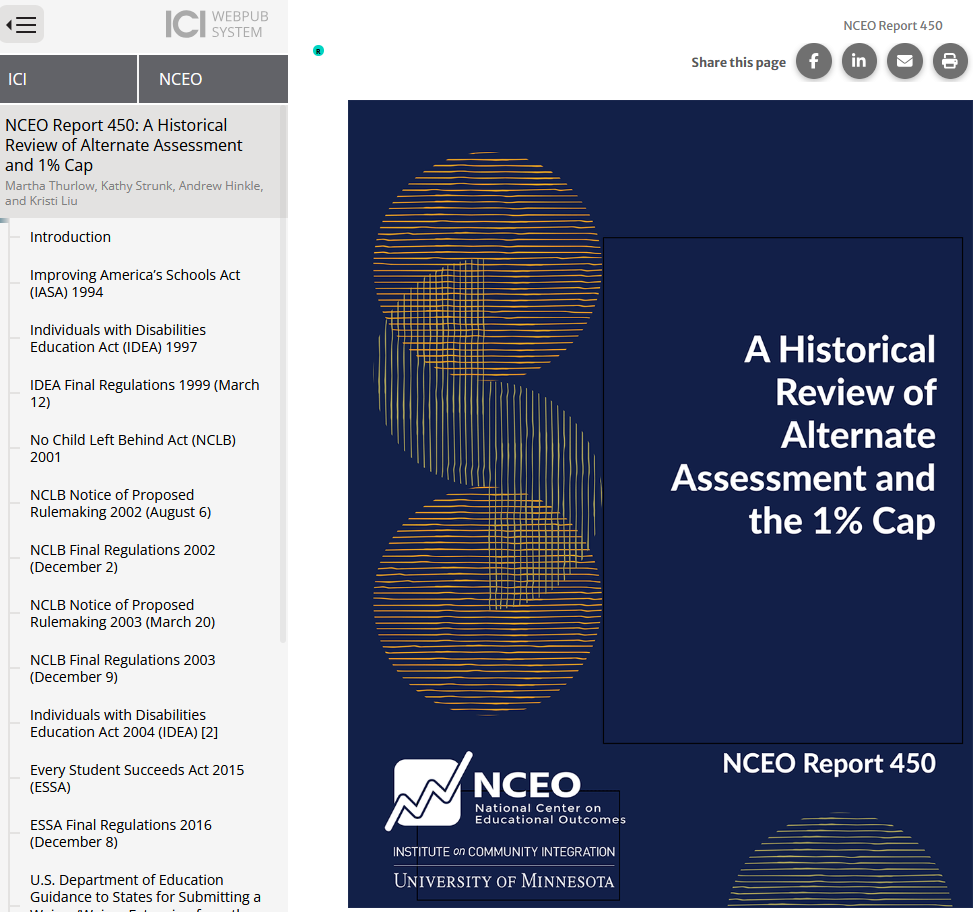
Next, in “New Web Publications,” we describe NCEO’s new web-based publications format. Launched over the summer, this is now our new publications standard, starting with Report 450. While this web-based format significantly improves accessibility for those who use screen readers, it also adds several user-friendly tools (like the Read to Me function) that make engaging with our resources simpler for everyone. Our article walks you through some of these enhancements.

Then, in “Technical Assistance Opportunities,” we share how we continue to provide technical assistance to state education agencies (SEAs) across the country. Learn more about how your state can connect with us for targeted or intensive support to meet your assessment and outcomes goals.

Finally, we’re sharing new NCEO resources. These three recent reports (NCEO Reports 450–452) include a historical review of alternate assessments, guidance for communicating SSIP data with stakeholders, and a summary of current research on K–12 test accommodations.

Happy reading!

Kristi Liu and Andrew Hinkle – Co-Directors


NCEO Celebrates 35 Years of Improving Outcomes for Students with Disabilities

Thirty-five years ago, the educational outcomes of students with disabilities were largely invisible. This fall, The National Center on Educational Outcomes (NCEO) celebrates 35 years as the longest-running technical assistance center dedicated to designing assessments and assessment policies that ensure all students count. As a center funded by the US Department of Education’s Office of Special Education Programs (OSEP), NCEO is a national leader in improving access to educational assessments and providing leadership on alternate assessments for students with disabilities.

read entire article

WebPubs format

NCEO’s New Web Publications: Enhancing Accessibility for Everyone

Starting this past summer, NCEO changed how it delivers all its publications. Having already provided only electronic publications for some time, all products are now served through a Web Publications format. While NCEO has used this format for select products in the past, this will now be our standard for delivering all publications going forward.

read entire article

Technical Assistance Opportunities with the National Center on Educational Outcomes

As NCEO celebrates our 35th anniversary, it’s important to note that NCEO’s work goes beyond publishing research and resources, we have also provided technical assistance for as many years. NCEO supports state education agencies (SEAs) in their efforts to improve outcomes for students with disabilities by providing targeted and intensive technical assistance on assessment-related topics. One specific focus is supporting states with State Systemic Improvement Plans (SSIPs) that have assessment-related State Identified Measurable Results (SiMRs). We also support states in their efforts to meet the federal limit on participation in the alternate assessment.

read entire article

New Resource: A Historical Review of Alternate Assessment and 1% Cap on Student Participation

This new report reviews the history of alternate assessments and the federal cap on state-level student participation rates. A Historical Review of Alternate Assessment and 1% Cap (NCEO Report 450) traces federal legislation, regulations, and Department of Education guidance from 1994 to 2025. This historical review includes a detailed account of how alternate assessments for students with the most significant cognitive disabilities have been developed, refined, and regulated over time.

read entire article

New Resource: State Discussion Guide for Communicating SSIP Data with Stakeholders

NCEO’s Technical Assistance team has published the new State Discussion Guide for Communicating SSIP Data with Stakeholders (NCEO Report 452). This guide was developed in collaboration with an NCEO-hosted Peer Learning Group comprising 58 participants from 26 states, ensuring the guide represents practical strategies and recommendations for meaningful communication practices.

read entire article

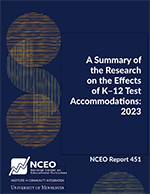
New Resource: A Summary of the Research on the Effects of K–12 Test Accommodations: 2023

This new report, A Summary of the Research on the Effects of K–12 Test Accommodations: 2023 (NCEO Report 451), presents a synthesis of the research literature published in 2023 on testing accommodations for U.S. elementary and secondary students with disabilities. NCEO has reported on accommodations research since 1999.

read entire article


The Center is supported through a Cooperative Agreement (#H326G210002) with the Research to Practice Division, Office of Special Education Programs, U.S. Department of Education. The Center is affiliated with the Institute on Community Integration at the College of Education and Human Development, University of Minnesota. Consistent with EDGAR §75.62, the contents of this report were developed under the Cooperative Agreement from the U.S. Department of Education, but do not necessarily represent the policy or opinions of the U.S. Department of Education or Offices within it. Readers should not assume endorsement by the federal government.

Project Officer: David Egnor

ICI and UMN logos

June 2025

Welcome

Greetings from NCEO as we slide into summer!

In this newsletter we highlight five key NCEO resources that explore various topics around the Alternate Assessment based on Alternate Academic Achievement Standards (AA-AAAS). Three of these are new resources, while the other two are popular past resources—our “In Case You Missed It” picks.

Our “New Resources” section includes:

  • A guide for developing requests for proposals (RFPs) for interim assessments that include all students.
  • A recent analysis on the inclusion of students who take an AA-AAAS in State Systemic Improvement Plans.
  • A report that examines state policies and research on alternate assessments.

Our “In Case You Missed It” section includes:

  • A report revisiting the definitions of depth, breadth, and complexity in alternate assessments.
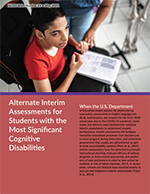
  • A resource exploring alternate interim assessments for students with the most significant cognitive disabilities.

Also, in this issue we provide information on NCEO presentations at the upcoming National Conference on Student Assessment (NCSA) and our joint forum with the Council of Chief State School Officers’ (CCSSO) Assessment, Standards, and Education of Students with Disabilities (ASES) collaborative. The Forum, titled At a Crossroads: The Intersection of AT, AAC, and AI in the Education of Diverse Learners, will follow NCSA. The Forum article includes information on how to register.

Kristi Liu and Andrew Hinkle – NCEO Co-Directors


New Resources:

Developing Requests for Proposals (RFPs) for Interim Assessments That Include All Students

Developing Requests for Proposals (RFPs) for Interim Assessments that Include All Students

State and district leaders tasked with developing requests for proposals (RFPs) for interim assessments face an important question: Are our RFPs ensuring that all students—including students with disabilities and English learners—can meaningfully demonstrate their knowledge and skills on these assessments? A new resource from NCEO provides the support you need. In NCEO Report 445, Developing Requests for Proposals (RFPs) for Interim Assessments that Include All Students, author Wesley Bruce presents clear, actionable guidance to help assessment staff develop RFPs that prioritize accessibility and inclusion from the start. The report includes sample language pulled from actual state RFPs to illustrate a variety of approaches, tailored to fit different state contexts and capacities.

read entire article

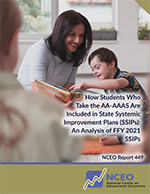
How Students Who Take the AA-AAAS Are Included in State Systemic Improvement Plans (SSIPs): An Analysis of FFY 2021 SSIPs

How Students Who Take the AA-AAAS are Included in State Systemic Improvement Plans (SSIPs); An Analysis of FFY 2021 SSIPs

Are students with the most significant cognitive disabilities left out of state improvement plans? A recent NCEO report, How Students Who Take the AA-AAAS are Included in State Systemic Improvement Plans (SSIPs); An Analysis of FFY 2021 SSIPs, reveals that many State Systemic Improvement Plans (SSIPs) are overlooking students participating in the Alternate Assessment based on Alternate Academic Achievement Standards (AA-AAAS).

read entire article

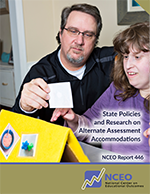
State Policies and Research on Alternate Assessment Accommodations

State Policies and Research on Alternate Assessment Accommodations

Are we doing enough to support students with the most significant cognitive disabilities? A 2025 report from NCEO titled State Policies and Research on Alternate Assessment Accommodations explores this question. It sheds light on the current state of research and policy regarding accommodations for alternate assessments taken by students with the most significant cognitive disabilities. State assessment systems have included these students since 2000, but research on alternate assessment accommodations policies is lacking. Further, the clarity and consistency of accommodations policies remain varied across states.

read entire article


In Case You Missed It:

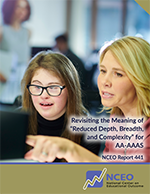
Revisiting the Meaning of “Reduced Depth, Breadth, and Complexity” for AA-AAAS

Revisiting the Meaning of “Reduced Depth, Breadth, and Complexity” for AA-AAAS

As states revise or refine their alternate assessments based on alternate academic achievement standards (AA-AAAS), one question continues to surface: What exactly do we mean by “reduced depth, breadth, and complexity”? Published in 2024, NCEO Report 441, Revisiting the Meaning of “Reduced Depth, Breadth, and Complexity” for AA-AAAS, provides the clarity states continue to need on this topic. The resource reviews the historical, legal, and practical roots of these terms. It also offers key questions state education agency staff can ask to sharpen their understanding and documentation of how the AA-AAAS reflects these concepts.

read entire article

Alternate Interim Assessments for Students with the Most Significant Cognitive Disabilities

Alternate Interim Assessments for Students with the Most Significant Cognitive Disabilities

Students with the most significant cognitive disabilities participate in state summative assessments by taking alternate assessments based on alternate academic achievement standards (AA-AAAS). But what happens the rest of the year? What tools do educators have to track progress, inform instruction, and make adjustments along the way? In 2021, NCEO Brief #23, Alternate Interim Assessments for Students with the Most Significant Cognitive Disabilities, highlighted a major gap in current assessment systems that still exists today: the lack of interim assessments designed specifically for students who take AA-AAAS. While general education students often benefit from interim assessments to monitor learning throughout the year, these tools are largely unavailable or inappropriate for students with the most significant cognitive disabilities.

read entire article


NCEO at the National Conference on Student Assessment (NCSA)

The Council of Chief State School Officers’ (CCSSO) annual National Conference on Student Assessment (NCSA) provides an opportunity for assessment practitioners to learn and reflect upon current and emerging trends in education and educational assessments. This year’s NCSA theme will be Maximizing Impact: Leveraging Assessment and Accountability to Drive Student Learning. NCSA will take place in Denver, Colorado on June 23-25, and NCEO staff members will participate in several sessions.

read entire article

Forum: At a Crossroads: The Intersection of AT, AAC, and AI in the Education of Diverse Learners

As generative Artificial Intelligence (AI), Assistive Technology (AT), and Augmentative and Alternative Communication (AAC) tools rapidly evolve and converge, they are transforming educational landscapes for diverse learners. On Wednesday, June 25, 2024, from 3:30 p.m. to 6:30 p.m., NCEO and the Council of Chief State School Officers’ (CCSSO) Assessment, Standards, and Education of Students with Disabilities (ASES) collaborative will jointly hold a forum, At a Crossroads: The Intersection of AT, AAC, and AI in the Education of Diverse Learners. This in-person forum will be held immediately following the National Conference on Student Assessment (NCSA) in Denver, Colorado.

read entire article


The Center is supported through a Cooperative Agreement (#H326G210002) with the Research to Practice Division, Office of Special Education Programs, U.S. Department of Education. The Center is affiliated with the Institute on Community Integration at the College of Education and Human Development, University of Minnesota. Consistent with EDGAR §75.62, the contents of this report were developed under the Cooperative Agreement from the U.S. Department of Education, but do not necessarily represent the policy or opinions of the U.S. Department of Education or Offices within it. Readers should not assume endorsement by the federal government.

Project Officer: David Egnor

February 2025

Happy New Year from NCEO!

As we begin 2025, we’re delighted to introduce ourselves as NCEO’s new Co-Directors. Both of us bring extensive experience in assessment and a shared commitment to ensuring all students have meaningful opportunities to demonstrate their knowledge and skills. As we collaborate on leadership and management decisions, Kristi will serve as the Principal Investigator and Andrew as the Co-Principal Investigator will continue to lead technical assistance efforts.

With spring testing season on the horizon, this newsletter focuses on providing essential resources to support decision making around assessment participation. You’ll find briefs on determining appropriate assessment paths for students – whether through general or alternate assessments – along with tools to help teams select and implement accessibility features that best meet individual student needs. The first article highlights some of our newest resources on assessment participation and accessibility features decisions. The second “In Case You Missed It” article describes a few of our favorite resources on accessibility features.

We’re also excited to share an article with updates about NCEO’s presence at several major spring conferences. NCEO and our project partners will be well-represented at CEC, AERA, NCME, and the National Parent Center Conference, where our staff will share recent research and activities, as well as lead discussions on inclusive assessment practices. These conferences provide excellent opportunities to engage in conversations about the latest developments in the field and connect with colleagues. We hope to see you there!

Kristi Liu and Andrew Hinkle, NCEO Co-Directors

New Resources on Selecting and Implementing Accessibility Features

As state education agencies (SEAs) prepare for spring testing, we want to share with you some new resources for improving assessment participation through the effective use of accessibility features. Many students, including students with and without disabilities, use accessibility features (universal features, designated features, and accommodations) to show what they know and can do on classroom and state assessments. Getting these accessibility features right is essential to all students participating in assessments and our assessments providing accurate and actionable data.

The English Learners with Disabilities Toolkit

The English Learners with Disabilities Toolkit (#1)

NCEO recently published a new series, The English Learners with Disabilities Toolkit, that provides resources for states and IEP teams to determine appropriate assessment participation for English learners with disabilities, particularly English learners with the most significant cognitive disabilities. Read entire article

Accommodations Toolkit

Accommodations Toolkit

One of NCEO’s most popular resources, the Accommodations Toolkit, has been updated! The toolkit is organized by accommodation or accessibility feature (e.g., tactile graphics, braille, test breaks, extended time, etc.), with easy-to-use research and policy summaries for each accommodation. The resources in the toolkit are designed to support the work of state education agencies, but may also be helpful to technical assistance providers, researchers, and others. Read entire article

In Case You Missed It: Favorite Resources on Selecting and Implementing Accessibility Features

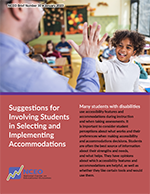
Student and Teacher Perceptions When Selecting and Implementing Accommodations

NCEO Brief 30

Selecting the appropriate accessibility features for every student is most effectively done with the involvement of all Individualized Education Program (IEP) team members, including students and teachers. NCEO has two briefs that focus on considering student and teacher perceptions when making decisions about selecting and implementing accommodations (see the following briefs: Suggestions for involving students in selecting and implementing accommodations (NCEO Brief #30) and Teacher perceptions and perspectives on the selection and implementation of accommodations (NCEO Brief #34. Read entire article

The Roles of Speech-language Pathologists and Psychologists in Selecting Accommodations

NCEO Report 430

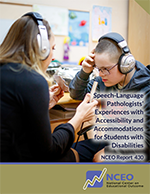
Depending on a student’s disabilities and needs, it may be important to include a speech pathologist or a school psychologist in the decision-making process. NCEO has resources on the roles of speech pathologists and school psychologists in selecting accommodations, see the following reports: Speech-language pathologists’ experiences with accessibility and accommodations for students with disabilities (NCEO Report 430) and School psychologists’ role in accommodations decision making (NCEO Brief #32). Read entire article

The School Leader Series

School Leader Series

School leaders play a key role in supporting assessment systems that are inclusive of all learners and provide opportunities for all students to participate in grade-level assessments. NCEO’s School Leader Series suggests a team approach, where there is shared responsibility for supporting the instruction and assessment of all students. Read entire article

Upcoming Presentations at CEC, CPIR, AERA, and NCME

NCEO and MIDAS staff will present at the annual conferences of the Council for Exceptional Children (CEC), the Center for Parent Information and Resources (CPIR), the National Council on Measurement in Education (NCME), and the American Education Research Association (AERA). Read entire article


The Center is supported through a Cooperative Agreement (#H326G210002) with the Research to Practice Division, Office of Special Education Programs, U.S. Department of Education. The Center is affiliated with the Institute on Community Integration at the College of Education and Human Development, University of Minnesota. Consistent with EDGAR §75.62, the contents of this report were developed under the Cooperative Agreement from the U.S. Department of Education, but do not necessarily represent the policy or opinions of the U.S. Department of Education or Offices within it. Readers should not assume endorsement by the federal government.

Project Officer: David Egnor

October 2024

Welcome

It’s the season of pumpkin spice latte, fall is in the air, and we have many things to share with you. The first article is about several reports published by a project affiliated with NCEO that share findings of research studies about students who shifted from the alternate assessment to the general assessment. The next article is about how states address the federal requirement that 95% of students participate in state assessments used for accountability. This is followed by an article on the unintended consequences of improved accessibility on state tests, and an article about the accommodations research literature.

Sheryl Lazarus, NCEO Director

MIDAS Project Addresses Needs of Students on the Border Between the Alternate and General Assessments

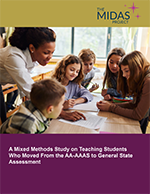
A Mixed Methods Study on Teaching Students Who Moved From the AA-AAAS to General State Assessment

Historically, some students were inappropriately identified to participate in the alternate assessment based on alternate academic achievement standards (AA-AAAS). States have worked diligently over the past several years to ensure that the right students are participating in the appropriate assessment. When students shift from the alternate assessment to the general assessment, educators sometimes do not know how to confidently provide them with the instruction and support they need.

read entire article

Two Pieces of a Puzzle: The 95% Participation Requirement in State Plans and States’ Opt-out Policies

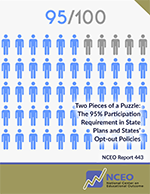
Two Pieces of a Puzzle: The 95% Participation Requirement in State Plans and States’ Opt-out Policies

The 2015 reauthorization of the Elementary and Secondary Education Act (ESEA), commonly known as the Every Student Succeeds Act (ESSA), limits participation in the alternate assessment based on alternate academic achievement standards (AA-AAAS) to 1% of a state’s tested population. The AA-AAAS is designed for students with the most significant cognitive disabilities. States may submit a waiver request to the U.S. Department of Education if they anticipate exceeding the 1% limit. One eligibility criterion for states seeking a waiver or waiver extension to the 1% cap is to show that at least 95% of all students, as well as 95% of students with disabilities, participated in the required state assessments used for accountability.

read entire article

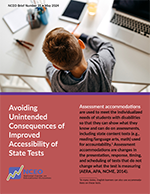
Avoiding Unintended Consequences of Improved Accessibility of State Tests

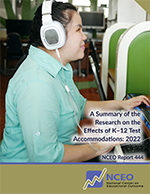
A Summary of the Research on the Effects of K-12 Test Accommodations: 2022.

Assessment accommodations are used to meet the individualized needs of students with disabilities so that they can show what they know and can do on national, state, and districtwide assessments. In the past, only accommodations were recognized as a way to increase the accessibility of tests for students with disabilities.

read entire article

Test Accommodations Research Literature

A Summary of the Research on the Effects of K-12 Test Accommodations: 2022

Research on test accommodations provides valuable information that informs policy and practice. The National Center on Educational Outcomes (NCEO) has reported on accommodations research since 1999. It recently published an update on the accommodations research literature published in 2022 titled A Summary of the Research on the Effects of K-12 Test Accommodations: 2022. This report presents a synthesis of the research literature on testing accommodations for U.S. elementary and secondary students (K–12).

read entire article


The Center is supported through a Cooperative Agreement (#H326G210002) with the Research to Practice Division, Office of Special Education Programs, U.S. Department of Education. The Center is affiliated with the Institute on Community Integration at the College of Education and Human Development, University of Minnesota. Consistent with EDGAR §75.62, the contents of this report were developed under the Cooperative Agreement from the U.S. Department of Education, but do not necessarily represent the policy or opinions of the U.S. Department of Education or Offices within it. Readers should not assume endorsement by the federal government.

Project Officer: David Egnor