Welcome!
Happy summer from the National Center on Educational Outcomes! Summer is a busy season for NCEO staff. Each June we participate in the National Conference on Student Assessment (NCSA), host our annual assessment forum on a key topic in the field, and attend the state collaboratives hosted by the Council of Chief State School Officers. This year, all of these activities will take place during the week of June 22nd in Austin, Texas.
In this issue, we begin with information about NCEO’s NCSA conference sessions and our post-conference assessment forum. If you are attending NCSA this year, we hope you will join us at one or more sessions and connect with our team.
We also highlight five recently published NCEO resources that include:
- Talking points on the importance of assessment participation for students with disabilities
- A multi-year analysis of state assessment participation rates, performance, and accommodations use for students with disabilities
- APR Snapshot 32 (2022–2023) on state assessment participation, performance, and assigned accommodations for students receiving special education services
- Updated links to state-level APR data for independent analysis
- A summary of 2024 research on assessment accommodations for students with disabilities
Finally, we share updates to one of NCEO’s most widely used resources, the Accommodations Toolkit. The toolkit provides easy-to-use summaries of the research literature on specific accommodations for students with disabilities along with companion accessibility policy analyses.
Kristi Liu and Andrew Hinkle
NCEO Co-Directors

NCEO at the National Conference on Student Assessment (NCSA)
The Council of Chief State School Officers’ (CCSSO) annual National Conference on Student Assessment (NCSA) provides an opportunity for assessment practitioners to learn and collaborate on current and emerging trends in education and educational assessments. This year’s NCSA theme is, Connecting the Dots: Building Coherent Systems to Support Student Success. NCSA will take place in Austin, Texas on June 22-24 and NCEO staff members will participate in several sessions.
Forum on Process Data: Understanding Student Use of Computer-based Assessment Tools
Computer-based assessments can generate a rich layer of information called process data (sometimes click data or log data) that captures how students interact with tests, not just whether they were assigned or used the accessibility tools available to them. On Wednesday, June 24, 2026, from 3:45 p.m. to 6:45 p.m., NCEO and the Council of Chief State School Officers’ (CCSSO) Assessment, Standards, and Education of Students with Disabilities (ASES) collaborative will jointly hold a forum, Process Data: Understanding Student Use of Computer-based Assessment Tools. This in-person forum will be held immediately following the National Conference on Student Assessment (NCSA) in Austin, Texas.
New Resources:
Talking Points on the Participation of Students with Disabilities in Statewide Assessments
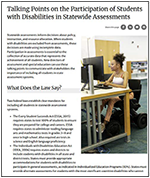
Statewide assessments inform important decisions about policy, instruction, and resource allocation. When students with disabilities are excluded from these assessments, those decisions are made using incomplete data. NCEO has released a new resource, Talking Points on the Participation of Students with Disabilities in Statewide Assessments, to help state directors and staff communicate the value of including all students in statewide assessments. This publication is the first tool in the “Participation Matters” series. It helps state leaders ensure that federal mandates for inclusion are met and advocate for the accurate data collection needed to represent the achievement of every learner.
State Assessment Rates of Participation, Performance, and Assigned Accommodations of Students with Disabilities (2007–08 Through 2022–23)
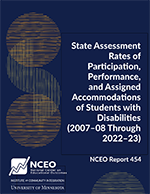
Tracking the long-term progress of students with disabilities requires a consistent record of state-level data. NCEO’s latest report, State Assessment Rates of Participation, Performance, and Assigned Accommodations of Students with Disabilities (2007–08 Through 2022–23) (NCEO Report 454), analyzes Annual Performance Report (APR) data. It covers each of the 50 states, along with 10 entities that receive Federal IDEA Part B funds. By organizing data from 16 school years into a single resource, this report enables stakeholders to examine trends for students with Individualized Education Programs (IEPs) in reading and mathematics. It includes information on the participation and performance of students with disabilities across years. These data cover state reading and mathematics assessments in grades 3–8 and high school.
2022-2023 APR Snapshot 32: State Assessment Participation, Performance, and Assigned Accommodations for Students Receiving Special Education Services
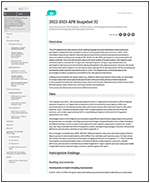
What does the most recent state-reported data tell us about the assessment experiences of 8th-grade students with disabilities? NCEO’s 2022-2023 APR Snapshot 32: State Assessment Participation, Performance, and Assigned Accommodations for Students Receiving Special Education Services provides a national analysis of participation and performance data for both general and alternate assessments (AA-AAAS) in reading/language arts and mathematics. Drawing from state Annual Performance Reports (APRs), this resource provides a picture of how students receiving special education services participated in the state assessment system and how they performed.
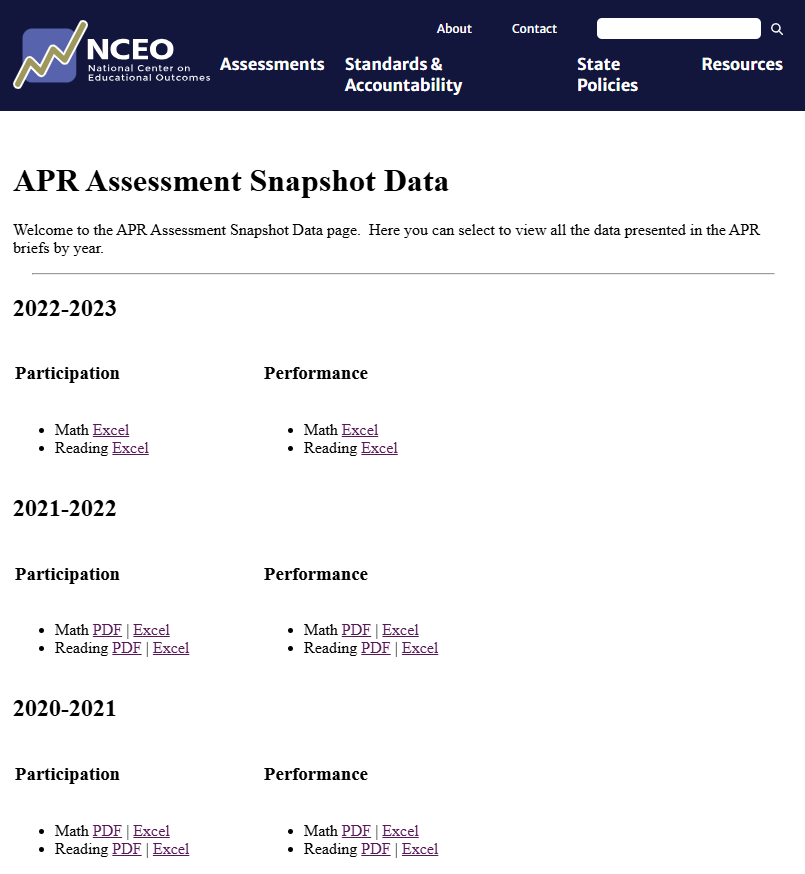
APR Assessment Snapshot Data (2007–08 through 2022–23)
While NCEO’s Snapshot Briefs analyze national trends using unidentified state data, the specific state-level results used for those reports are available through the NCEO APR Snapshot Data Page. This resource provides identified participation, performance, and testing accommodation data for the states and federal entities included in each APR Snapshot Brief.
A Summary of the Research on the Effects of K–12 Test Accommodations: 2024
What does recent research tell us about the use and effects of K–12 test accommodations for students with disabilities? NCEO’s latest annual review, A Summary of the Research on the Effects of K–12 Test Accommodations: 2024 (NCEO Report 453), summarizes 13 studies published in 2024. The report examines trends in the accommodations research literature, including study types, research methods, student populations, accommodations studied, and the purposes of recent research.
Updates Made to NCEO’s Accommodations Toolkit
NCEO has made updates to the Accommodations Toolkit. The toolkit provides easy-to-use summaries of the academic research literature on specific accommodations for students with disabilities as well as companion accessibility policy analyses. The Accommodations Toolkit is organized by accommodation and currently includes research summaries for 29 accommodations. The toolkit also includes policy analyses that summarize how each accommodation was included in states’ accessibility policies. The resources in the toolkit are designed to support the work of state education agencies, but may also be helpful to technical assistance providers, researchers, and others.
The Center is supported through a Cooperative Agreement (#H326G210002) with the Research to Practice Division, Office of Special Education Programs, U.S. Department of Education. The Center is affiliated with the Institute on Community Integration at the College of Education and Human Development, University of Minnesota. Consistent with EDGAR §75.62, the contents of this report were developed under the Cooperative Agreement from the U.S. Department of Education, but do not necessarily represent the policy or opinions of the U.S. Department of Education or Offices within it. Readers should not assume endorsement by the federal government.
Project Officer: Kristen Rhoads
