Category Archives: Uncategorized

June 2024

Welcome

Greetings from NCEO! In this issue, we highlight several resources on accommodations and accommodations decision making. We also provide information on NCEO presentations at the upcoming National Conference on Student Assessment (NCSA). 

The first article is about several resources on student and teacher perspectives about accommodations. The next article clarifies what the terms “accommodations” and “modifications” mean for both instruction and assessment for students with disabilities, followed by an article that provides information about NCEO’s updated Accommodations Toolkit.

Additionally, in case you missed it, this issue includes information about a video series NCEO produced several years ago that shares the story of how accommodation decisions were made and implemented for a student.

We finish the issue with all the sessions in which NCEO is participating during the National Conference on Student Assessment (NCSA) and an article on the forum on Unlocking Potential: Harnessing Artificial Intelligence for Inclusive Learning that follows NCSA. The article includes information on how to register for the forum.

Sheryl Lazarus, NCEO Director
Student and Teacher Perceptions of Accommodations

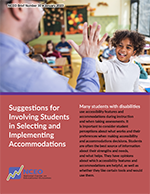
Many students with disabilities use accommodations during instruction and when taking assessments. It is important to consider student perceptions about what works as well as their preferences when making accessibility and accommodations decisions. Students are often the best source of information about their strengths and needs. Similarly, it is vital to better understand teachers’ perspectives regarding various accommodations and accessibility features. What have they found to work well? What is challenging about selecting or implementing various accommodations?
read entire article

The Basics of Accommodations and Modifications

There continues to be confusion among some educators and staff in State Education Agencies (SEAs) and Local Education Agencies (LEAs) about what is an accommodation and what is a modification. A recently published NCEO Brief, The Basics of Accommodations and Modifications (Brief #33), clarifies what accommodations and modifications are for both instruction and assessment for students with disabilities. The Brief also disentangles the use of the term “alternate or modified curriculum” from the meaning of modification used for instruction and assessment.
read entire article

Accommodations Toolkit

NCEO has an Accommodations Toolkit that provides easy-to-use summaries of the academic research literature on specific accommodations for students with disabilities as well as companion accessibility policy analyses. The Accommodations Toolkit is organized by accommodation and currently includes research summaries for 29 accommodations.
read entire article

Videos About Accommodations Decision Making

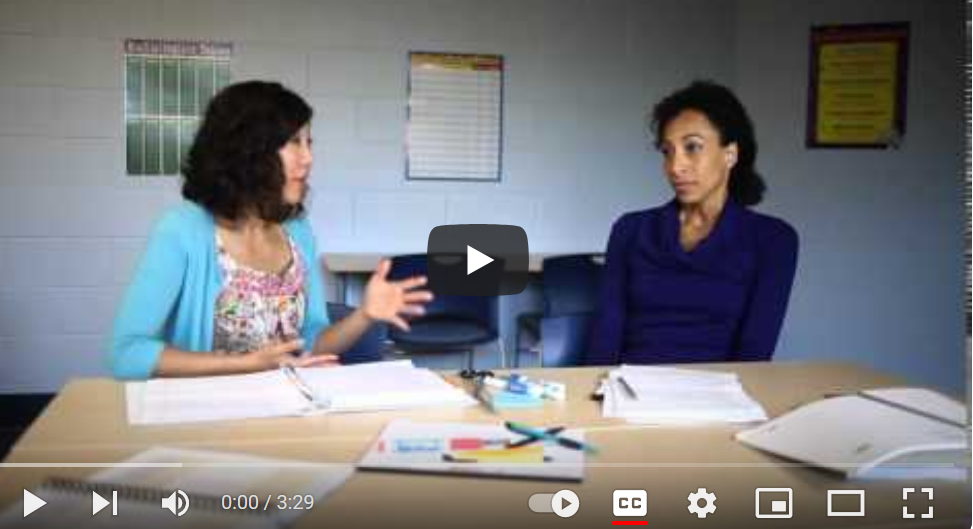
NCEO produced a series of videos several years ago that told the story of how a team of educators worked with a student and her family to help ensure that she had an accommodation she needed to meaningfully access instruction and assessments. This series continues to be extremely popular, and many people have told NCEO how helpful the videos are. We are sharing these “oldies, but goodies” again in case you missed them. This series of videos is available on the NCEO YouTube channel

read entire article

NCEO at the National Conference on Student Assessment (NCSA)

The Council of Chief State School Officers’ (CCSSO) annual National Conference on Student Assessment (NCSA) provides an opportunity for assessment practitioners to learn and reflect upon current and emerging trends in education and educational assessments. This year’s NCSA theme will be Designing an Effective, Coherent Assessment System for All Learners. NCSA will take place in Seattle, Washington on June 24-26, and NCEO staff members will participate in several sessions,

read entire article

Forum: Unlocking Potential: Harnessing AI for Inclusive Learning

Artificial intelligence, or AI, is becoming ingrained in every aspect of our lives. From helping us plan trips to checking the grammar in our emails, or even producing artwork, AI use has become an everyday occurrence. As AI continues to integrate into our lives and into the various systems of our society, the questions of how AI will influence education arise. On Wednesday, June 26, 2024, from 3:30 p.m. to 6:30 p.m., NCEO and the Council of Chief State School Officers’ (CCSSO) Assessment, Standards, and Education of Students with Disabilities (ASES) Collaborative will jointly hold a forum on Unlocking Potential: Harnessing AI for Inclusive Learning where participants will come together to develop a better understanding of how artificial intelligence is changing the field of education, focusing specifically on the use of AI in assessment and instruction for students with disabilities, English learners, and English learners with disabilities. This in-person forum will be held immediately following the National Conference on Student Assessment (NCSA) in Seattle, Washington.

read entire article


The Center is supported through a Cooperative Agreement (#H326G210002) with the Research to Practice Division, Office of Special Education Programs, U.S. Department of Education. The Center is affiliated with the Institute on Community Integration at the College of Education and Human Development, University of Minnesota. Consistent with EDGAR §75.62, the contents of this report were developed under the Cooperative Agreement from the U.S. Department of Education, but do not necessarily represent the policy or opinions of the U.S. Department of Education or Offices within it. Readers should not assume endorsement by the federal government.

Project Officer: David Egnor
February 2024

Welcome

2024 greetings from NCEO. In this newsletter, we are featuring several NCEO resources that address English learners with disabilities. The number of school-age English learners with disabilities is increasing, and greater attention is being given to their inclusion in state and district assessments. The first article is about an interactive tool that allows the creation of custom reports on the number and percentage of English learners with disabilities by disability category. Other articles discuss a resource on understanding the characteristics of English learners with disabilities, a framework for the identification of students eligible for alternate English proficiency (alt-ELP) assessments, and a guidebook for states on including students with disabilities, English learners, and English learners with disabilities in assessments. There is also an article about several NCEO webpages that contain links to state assessment policies and data for English learners with disabilities.

Additionally, this issue contains an article about a recent National Council of Measurement in Education (NCME) Fireside Chat on considerations for the inclusion of students with disabilities in large-scale assessment in the past, present, and future that featured a NCEO staff member.  This newsletter concludes with lists of upcoming NCEO presentations at the annual Council for Exceptional Children (CEC), American Educational Research Association (AERA), and NCME conferences.

Sheryl Lazarus, NCEO Director

Number and Percentage of English Learners with Disabilities by Disability Category

The National Center on Educational Outcomes (NCEO) recently published an interactive web-based tool, titled, Number and Percentage of English Learners with Disabilities by Disability Category, 2012-13 to 2020-21 (NCEO Data Analytics #18). This product presents information on the percentage of students with disabilities ages 6-21 who are also English learners (i.e., English learners with disabilities), and the proportion of these students for each of the 13 federal disability categories.

read entire article

Understanding the Characteristics of English Learners with Disabilities

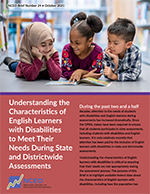
Since the 1990s, states have been mandated to ensure the inclusion of all students in assessments, including students with disabilities and English learners. English learners with disabilities are students who are in both of these groups. The National Center on Educational Outcomes (NCEO) has a brief titled Understanding the Characteristics of English Learners with Disabilities to Meet Their Needs During State and Districtwide Assessments (NCEO Brief #24) that highlights federal data on the characteristics of English learners with disabilities, and shows changes in the population over time.

read entire article

A Framework for Making Decisions About Participation in a State’s Alternate ELP Assessment

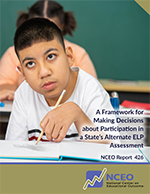
A Framework for Making Decisions About Participation in a State’s Alternate ELP Assessment (NCEO Report 426), which was published by the National Center on Educational Outcomes (NCEO), offers state education agencies guidance on identifying English learners eligible for alternate English language proficiency (alt-ELP) assessments due to significant cognitive disabilities. It emphasizes the challenges in determining eligibility, particularly the interplay between language and cognitive ability.

read entire article

Guidebook on Including Students with Disabilities, English Learners, and English Learners with Disabilities in Assessments

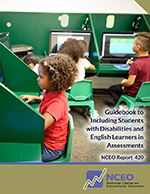
The Guidebook to Including Students with Disabilities and English Learners in Assessments (NCEO Report 420) provides 10 lessons about how to ensure inclusive assessment practices for students with disabilities, English learners, and English learners with disabilities. It is directed to state department of education staff and others interested in ensuring that assessments and assessment policies are inclusive of all students in the most appropriate ways possible.

read entire article

Links to State Policies on Assessment of English Learners with Disabilities

Did you know that NCEO regularly compiles and updates information on state policies related to the assessment of English learners with disabilities? If you have questions about what states allow or how states’ policies are worded, check out the webpages.

read entire article

Fireside Chat on Including Students with Disabilities in Large-Scale Assessments

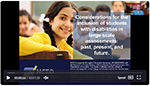
The National Center on Educational Outcomes’ (NCEO’s) Andrew Hinkle gave a Fireside Chat for the National Council on Measurement in Education’s (NCME) Large-Scale Assessment Special Interest Groups in Measurement in Education (SIGIMIE) titled, Considerations for the Inclusion of Students with Disabilities in Large-Scale Assessment: Past, Present, and Future.

read entire article

Upcoming NCEO Presentations at CEC, AERA, and NCME

NCEO staff will present at the annual conferences of the Council for Exceptional Children
(CEC), the National Council on Measurement in Education (NCME), and the American
Education Research Association (AERA).

read entire article


The Center is supported through a Cooperative Agreement (#H326G210002) with the Research to Practice Division, Office of Special Education Programs, U.S. Department of Education. The Center is affiliated with the Institute on Community Integration at the College of Education and Human Development, University of Minnesota. Consistent with EDGAR §75.62, the contents of this report were developed under the Cooperative Agreement from the U.S. Department of Education, but do not necessarily represent the policy or opinions of the U.S. Department of Education or Offices within it. Readers should not assume endorsement by the federal government.

Project Officer: David Egnor
October 2023

Welcome

Effective communication is a cornerstone for fostering collaboration, understanding, and ultimately, student success. Recognizing the importance of communication, we are featuring in this newsletter some of NCEO’s resources for parents and families. The first article is about NCEO’s new Empowering Parents Toolkit which includes videos, one-page flyers, and example social media posts on assessments and assessment-related state systemic improvement plans (SSIPs). Be sure to check out my personal favorite in this series: the video on why assessments are important, and why children with disabilities should participate in them. It is available in English and Spanish.

The next article is about several powerful fact sheets that state education agencies, districts, and schools can use to engage parents and families and enhance their understanding of state assessments. In this issue, there is also an article about several resources for parents and families in NCEO’s Participation Communications Toolkit, including 1-page—as well as customizable—flyers for parents and students.

Additionally, in case you missed them, this issue includes information about several “oldies but goodies” for parents and families.

This issue also includes an article about several other recently published NCEO resources. These resources include a Brief on the school psychologist’s role in accommodations decision making, a report on the relationship between student placement and alternate assessment participation rates, and a report sharing the findings of an analysis of states’ 2021-22 participation guidelines and definitions for alternate assessments based on alternate academic achievement standards (AA-AAAS). 

NCEO is active on social media! Follow us to receive regular updates on our activities.

Sheryl Lazarus, NCEO Director

Engaging and Enabling Parents: Empowering Parents Toolkit

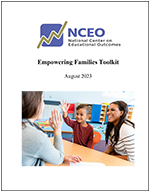
This image has an empty alt attribute; its file name is PLG-Empowering-Parents-Toolkit_thumbnail.png

The National Center on Educational Outcomes (NCEO) recently published the Empowering Families Toolkit. The purpose of the toolkit is to provide accessible materials for parents about topics related to assessments, and assessment-related State Systemic Improvement Plans (SSIPs) and State-Identified Measurable Results (SIMRs) that states commit to reaching. These materials are designed to help support parent participation in stakeholder meetings.

read entire article

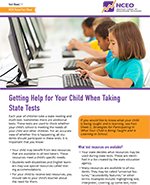
This image has an empty alt attribute; its file name is NCEOParentFactSheet1.png

Building Trust Through Two-Way Communication: Assessment Fact Sheets for Parents

The National Center on Educational Outcomes (NCEO) recently published four parent fact sheets with information about student participation in state tests. These engaging Fact Sheets provide easily accessible basic information about state tests, as well as instruction.

read entire article

Unlocking the Power of Communication: NCEO’s Participation Communication Toolkit

This image has an empty alt attribute; its file name is Participation-Comm-Toolkit-cover-for-Web.jpg

State test participation has benefits for students, their families, and their schools. The National Center on Educational Outcomes (NCEO) recently updated its Participation Communications Toolkit. It is intended to provide a neutral but useful mechanism to guide positive, thoughtful conversations about student testing participation.

read entire article

Oldies But Goodies: NCEO Parent Resources You May Have Missed

One of the National Center on Educational Outcomes (NCEO’s) all-time most popular resources for parents is an infographic about the implications of assessment participation decisions. Start with the End in Mind: An Infographic to Guide Decisions about Student Participation in the Alternate Assessment provides guidance about IEP team decision making for a student’s participation in the state’s alternate assessment aligned with alternate academic achievement standards (AA-AAAS).

read entire article

Other Recently Published NCEO Resources

This image has an empty alt attribute; its file name is NCEOBrief32_thumbnail.png

In addition to the parent resources highlighted in this newsletter, NCEO recently published several other new products, including School Psychologists’ Role in Accommodations Decision Making (NCEO Brief #32), The Relationship between Student Placement and AA-AAAS Participation Rates (NCEO Report #439), and 2021-22 Participation Guidelines and Definitions for Alternate Assessments Based on Alternate Academic Achievement Standards (NCEO Report #440).

read entire article

The Center is supported through a Cooperative Agreement (#H326G210002) with the Research to Practice Division, Office of Special Education Programs, U.S. Department of Education. The Center is affiliated with the Institute on Community Integration at the College of Education and Human Development, University of Minnesota. Consistent with EDGAR §75.62, the contents of this report were developed under the Cooperative Agreement from the U.S. Department of Education, but do not necessarily represent the policy or opinions of the U.S. Department of Education or Offices within it. Readers should not assume endorsement by the federal government.

Project Officer: David Egnor
June 2023

Welcome

Summer greetings from NCEO! In this issue, we highlight some new NCEO products, as well as several upcoming events. The first article is about two new tools that can be used to develop state and district assessment participation action plans. Next is an article about gaps in the accommodations research literature.

This issue includes a summary of all the sessions in which NCEO is participating during the National Conference on Student Assessment (NCSA). Finally, there is an article on the forum on What Does Meaningful Accessibility Really Mean? that follows NCSA. The article includes information on how to register for the forum.

– Sheryl Lazarus, NCEO Director

Tools for Developing State and District Assessment Participation Action Plans

NCEO Tool #13

The Every Student Succeeds Act (ESSA) allows for states to apply for a waiver from the U.S. Department of Education if they think they will exceed the 1% cap on alternate assessment participation for students with the most significant cognitive disabilities. However, in order for a state to receive a waiver, it must meet the ESSA requirement that 95 percent of all students, as well as 95 percent of students with disabilities, participated in accountability assessments. For states wanting to improve student assessment rates, NCEO published two new companion resources.

read entire article

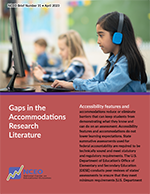
Gaps in the Accommodations Research Literature

NCEO Brief #31

There is an urgent need for additional knowledge about how to appropriately use accommodations to ensure that assessments are accessible and validly measure what students know and can do. A recently published NCEO Brief, Gaps in the Accommodations Research Literature (NCEO Brief #31), presents consolidated information about gaps in the research literature on assessment accommodations.

read entire article

NCEO at the National Conference on Student Assessment (NCSA)

The Council of Chief State School Officers’ (CCSSO) annual National Conference on Student Assessment (NCSA) provides an opportunity for assessment practitioners to learn and reflect upon current and emerging trends in education and educational assessments. This year’s NCSA theme will be Improving Student Learning for All: Advancing Innovative Uses of Assessment Data. NCSA will take place in New Orleans, Louisiana on June 26-28, and NCEO staff members will participate in several sessions.

read entire article

Forum on What Does Meaningful Accessibility Really Mean?

Most of us use technology devices every day. Yet, many of the same technologies that we take for granted to access our world and that students use in their day-to-day lives are not always available to them in the classroom and are not permitted on assessments. On Wednesday, June 28, 2023, from 3:30 p.m. to 6:30 p.m., NCEO and the Council of Chief State School Officers’ (CCSSO) Assessment, Standards, and Education of Students with Disabilities (ASES) collaborative will jointly hold a forum on issues surrounding the use of technology students use in their day-to-day lives and what that means for assessment participation.

read entire article

The Center is supported through a Cooperative Agreement (#H326G210002) with the Research to Practice Division, Office of Special Education Programs, U.S. Department of Education. The Center is affiliated with the Institute on Community Integration at the College of Education and Human Development, University of Minnesota. Consistent with EDGAR §75.62, the contents of this report were developed under the Cooperative Agreement from the U.S. Department of Education, but do not necessarily represent the policy or opinions of the U.S. Department of Education or Offices within it. Readers should not assume endorsement by the federal government.

Project Officer: David Egnor
February 2023

Welcome

Greetings from NCEO in a new year. The year 2023 arrived quickly, and a lot already is happening. I always enjoy working with the team that pulls together the NCEO eNewsletters. As we work to select which products and activities to highlight, it is a wonderful opportunity to reflect on the many things that NCEO is doing

In this issue we share information about four new products: a disproportionality calculator tool that can be used to examine disproportionality with respect to student subgroup participation in the alternate assessment; a brief on including students with disabilities in K-2 assessments; a brief on involving students with disabilities in selecting accessibility features and accommodations; and a policy analysis of how states’ policies address the qualifications and training requirements for test administrators, proctors, and accommodations providers.

Additionally, this issue contains an updated list of accommodations included in the NCEO Accommodations Toolkit. There is both a research summary and a policy analysis for each accommodation included in the toolkit. 

Finally, in this issue, we provide information on sessions at the annual conferences of the Council for Exceptional Children (CEC), the National Council on Measurement in Education (NCME), and the American Education Research Association (AERA) that include NCEO staff.

As always, we welcome feedback and ideas about what you would like to see in future issues of NCEO’s eNewsletter. We enjoy hearing from you.

– Sheryl Lazarus, NCEO Director

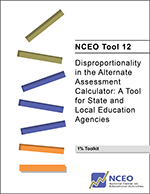
Disproportionality Calculator for Alternate Assessment Participation

This image has an empty alt attribute; its file name is Tool-12-cover-w-border-thumbnail.png

Students who do not have the most significant cognitive disabilities may sometimes be inappropriately assigned to participate in the alternate assessment based on alternate academic achievement standards (AA-AAAS). There is concern that a disproportionate percentage of students from some racial and ethnic subgroups may be over-identified as having a most significant cognitive disability and inappropriately assigned to this assessment.

read entire article

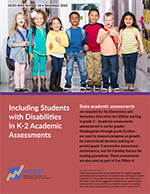
Including Students with Disabilities in K-2 Assessments

Many states and school districts have implemented K-2 academic assessments. These assessments are often used to measure progress or growth, for instructional decision-making, to predict grade 3 summative assessment performance, or to track literacy for reading guarantees. They may also be used in some State Systemic Improvement Plans (SSIPs), as either the State-Identified Measurable Result (SIMR) or as a measure of progress in a state’s evaluation plan for its SSIP.

read entire article

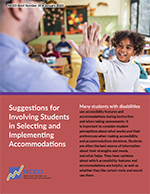
Involving Students in Selecting and Implementing Accommodations

Many students with disabilities use accessibility features and accommodations during instruction and when taking assessments. It is important to consider student perceptions about what works and their preferences when making accessibility and accommodations decisions. Students are often the best source of information about their strengths and needs, and what helps.

read entire article

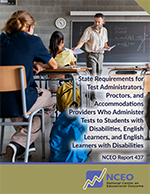
New Report Documents State Policies for Test Administrators, Proctors, and Accommodations Providers

To help ensure that assessments are properly administered, states have developed policies about who can administer or proctor assessments and the training they must have. Similarly, states have policies regarding who can provide accommodations to help ensure that the accommodations are provided appropriately. Little is known about these policies.

read entire article

Updated Accommodations Toolkit

NCEO publishes an Accommodations Toolkit that continues to expand. This toolkit provides easy-to-use summaries of the academic research literature on specific accommodations for students with disabilities as well as companion state policy analyses summarizing how each accommodation is included in states’ assessment accessibility policies.

read entire article

Upcoming NCEO Presentations at CEC, NCME, and AERA

NCEO staff will present at the annual conferences of the Council for Exceptional Children (CEC), the National Council on Measurement in Education (NCME), and the American Education Research Association (AERA).

read entire article

The Center is supported through a Cooperative Agreement (#H326G210002) with the Research to Practice Division, Office of Special Education Programs, U.S. Department of Education. The Center is affiliated with the Institute on Community Integration at the College of Education and Human Development, University of Minnesota. Consistent with EDGAR §75.62, the contents of this report were developed under the Cooperative Agreement from the U.S. Department of Education, but do not necessarily represent the policy or opinions of the U.S. Department of Education or Offices within it. Readers should not assume endorsement by the federal government.

Project Officer: David Egnor