Category Archives: Uncategorized

February 2021

Welcome

Welcome to the Winter NCEO e-newsletter. This issue highlights a new video series for parents of students with significant cognitive disabilities. The videos focus on various aspects of supporting the learning of their children at home. Currently available videos address routines at home, helping with academics at home, foundations of communications at home, and communications at home.

This issue also highlights a new Brief that NCEO published on using pre-assessment to plan instruction for students with disabilities during distance education, as well as a review of the literature on literacy assessment and instruction practices for English learners with significant cognitive disabilities. Additionally, there is an article about eight tools which were developed with states that were members of several Peer Learning Groups (PLGs) organized by NCEO on topics related to addressing the 1% threshold on participation in alternate assessments based on alternate academic achievement standards (AA-AAAS).  Finally, if you will be participating in the upcoming virtual Council for Exceptional Children (CEC) Convention and Expo, we have a list of sessions that include NCEO staff.

As always, we welcome feedback and ideas about what you would like to see in future issues of NCEO’s e-newsletter.

Sheryl Lazarus
NCEO Director


Parent Video Series to Support the Learning of Children with Significant Cognitive Disabilities at Home
Parent Resources Video SeriesNCEO and the TIES Center, both funded by the Office of Special Education Programs, have jointly published the first four videos in a series for parents of K-12 students with significant cognitive disabilities. The videos, available on NCEO’s YouTube Channel address various aspects of supporting the learning of children with significant cognitive disabilities at home.

read entire article


Brief on Pre-assessment to Plan Instruction for Students with Disabilities During Distance Learning
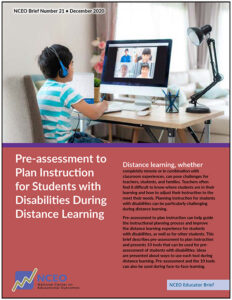
Brief on Pre-assessment to Plan Instruction for Students with Disabilities During Distance LearningNCEO recently published Pre-assessment to Plan Instruction for Students with Disabilities During Distance Learning (NCEO Brief #21). This Brief describes using pre-assessment to plan instruction for students with disabilities, and presents 10 tools that can be used particularly during distance learning. Pre-assessment to plan instruction can help guide the instructional planning process and focus on the specific content to be taught in a unit or sequence of lessons.

read entire article


New NCEO Report Reviewing the Literature on Literacy Assessment and Instruction Practices for English Learners with Significant Cognitive Disabilities
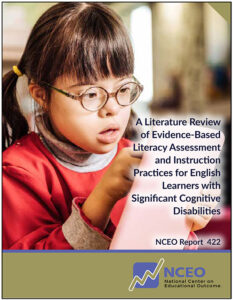
A Literature Review on Evidence-Based Literacy Assessment and Instruction Practices for English Learners with Significant Cognitive DisabilitiesNCEO has published A Literature Review on Evidence-Based Literacy Assessment and Instruction Practices for English Learners with Significant Cognitive Disabilities  (NCEO Report #422). This report summarizes a comprehensive investigation of research published between 2000 and 2018 on evidence-based literacy assessment and instruction practices for English learners with the most significant cognitive disabilities. Our goal is to provide policymakers and educators with actionable findings from the literature.

read entire article


Alternate Assessment Resources from NCEO 1% Peer Learning Groups
IEP Team Resource: Making Decisions about Participation in the Alternate AssessmentIn October 2018, more than 200 individuals gathered in Boston to develop state-action plans for meeting the 1% cap on state-level participation in alternate assessments aligned with alternate academic achievement standards (AA-AAAS). Then in 2019, states met with each other and NCEO in a series of Peer Learning Groups (PLGs) to develop resources to help themselves and other states address the 1% cap requirement. Eight tools were developed through these three PLGs. Each tool is described in brief here.

read entire article


NCEO Presentations at Council for Exceptional Children Convention and Expo
The Council for Exceptional Children’s (CEC) annual conference will be held virtually from March 8 through March 13, 2021. NCEO staff will be involved in several presentations and posters. If you plan to attend this conference, we invite you to attend conference presentations and posters by NCEO staff members and affiliated projects.

read entire article


NCEO’s National Assessment Center is supported through a Cooperative Agreement (#H326G160001) with the Research to Practice Division, Office of Special Education Programs, U.S. Department of Education. The Center is affiliated with the Institute on Community Integration at the College of Education and Human Development, University of Minnesota. The contents of this report were developed under the Cooperative Agreement from the U.S. Department of Education, but do not necessarily represent the policy or opinions of the U.S. Department of Education or Office within it. Readers should not assume endorsement by the federal government.
Project Officer: David Egnor

October 2020

Welcome

These are challenging times, and it has been an unprecedented year, but I continue to be amazed by the resilience of NCEO staff and the incredible work they are doing to address new needs and issues. In this issue, I am pleased to share information about a few of the resources and products staff have developed to meet needs.

This issue highlights translations of several NCEO and affiliated center products. One or more publications are now available in each of the following languages: Arabic, Traditional Chinese, Simplified Chinese, Spanish, and Vietnamese. It also highlights a new guidebook on including students with disabilities and English learners in assessments, and the resources available from several webinars that NCEO conducted for the U.S. Department of Education’s Office of Elementary and Secondary Education (OESE). Additionally, this newsletter highlights two new briefs on access to the general education curriculum by students with the most significant cognitive disabilities, as well as several new distance learning resources.

Sheryl Lazarus, NCEO Director


Translations of Selected Products Now Available

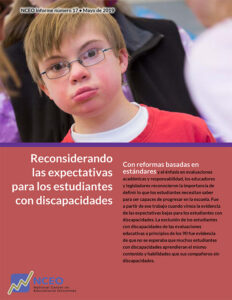
Reconsiderandolas expectativas para los estudiantes con discapacidadesSelected publications of NCEO and affiliated projects have been translated into several languages. Reconsiderandolas expectativas para los estudiantes con discapacidades is a Spanish translation of Students with Disabilities in Educational Policy, Practice, and Professional Judgment: What Should We Expect? The purpose of this brief is to summarize some of the past exclusionary practices that resulted from low expectations for students with disabilities, and how those were addressed in policies related to standards-based reform.

read entire article


Guidebook to Including Students with Disabilities and English Learners in Assessments

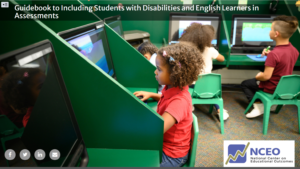
Guidebook to Including Students with Disabilities and English Learners in Assessments NCEO recently published the Guidebook to Including Students with Disabilities and English Learners in Assessments. This Guidebook was developed to highlight the lessons learned about how to ensure inclusive assessment practices for students with disabilities and English learners. It also provides foundational information on the characteristics of these students that require consideration during all phases of assessment design, development, and implementation.

read entire article


PowerPoints and Videos Available for Webinars Conducted for the Office of Elementary and Secondary Education (OESE)

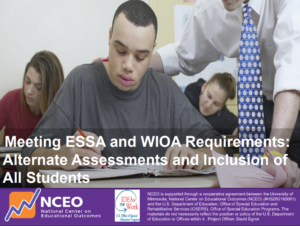
NCEO recently conducted three webinars for the U.S Departments of Education’s Office of Elementary and Secondary Education (OESE) on topics related to peer review and students with disabilities. The webinars were: (1) Meeting Every Student Succeeds Act (ESSA) and Workforce Innovation and Opportunity Act (WIOA) Requirements: Alternate Assessments and Inclusion of All Students; (2) How Do We Lower our Alternate Assessment Participation Rate?  Five States Share their Stories; and (3) Successfully Making and Implementing Participation and Accommodations Decisions for English Learners with Disabilities.

read entire article


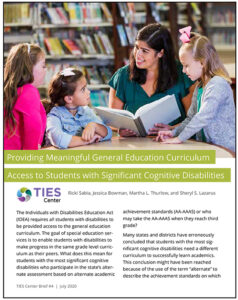
Providing Meaningful General Education Curriculum Access to Students with Significant Cognitive Disabilities (TIES Center Brief #4)Two New Briefs on Access to the General Education Curriculum by Students with the Most Significant Cognitive Disabilities

TIES Center, a center affiliated with NCEO, recently published two briefs on access to the general education curriculum by students with the most significant cognitive disabilities.

read entire article


New Additions to TIES Center’s Distance Learning Series

TIES Center Distance Learning SeriesA NCEO affiliated center, TIES Center, has a distance learning series that provides a framework for students with the most significant cognitive disabilities to participate in distance learning, engage fully in academics online, and interact with their teachers and peers, a critical component of well-being. TIES Center is regularly adding resources to this series to support the inclusion and engagement of students with significant cognitive disabilities.

read entire article


NCEO’s National Assessment Center is supported through a Cooperative Agreement (#H326G160001) with the Research to Practice Division, Office of Special Education Programs, U.S. Department of Education. The Center is affiliated with the Institute on Community Integration at the College of Education and Human Development, University of Minnesota. The contents of this report were developed under the Cooperative Agreement from the U.S. Department of Education, but do not necessarily represent the policy or opinions of the U.S. Department of Education or Office within it. Readers should not assume endorsement by the federal government.
Project Officer: David Egnor

June 2020

Welcome

Welcome to NCEO’s June newsletter. It has been a very busy spring at NCEO. Staff are focusing on new issues and questions that have arisen as a result of COVID-19, while continuing the work that NCEO has always done.

In this issue, we highlight several new resources that address various aspects of distance learning, including a new brief on formative assessment strategies to improve distance learning outcomes for students with disabilities. We also are highlighting resources in the continually growing series on distance learning that is being developed by TIES Center, which is a NCEO affiliated project. This series is focused on instruction and engagement of students with significant cognitive disabilities in a distance learning environment.

This issue also includes an article about a new brief on multi-tiered systems of support (MTSS) for all students, including students with significant cognitive disabilities, as well as an article about several new interactive Data Analytics which enable users to explore and visualize data about assessment participation and performance. We conclude with two articles about products created by a NCEO affiliated project, the Improving Instruction for English Learners Through Accessibility Decision Making project – a report that presents the findings of a literature review on research on test accommodations for English learners and English learners with disabilities, and information about two new professional development modules on accessibility decision making.

Sheryl Lazarus, NCEO Director


Brief on Formative Assessment Strategies to Improve Distance Learning Outcomes for Students with Disabilities

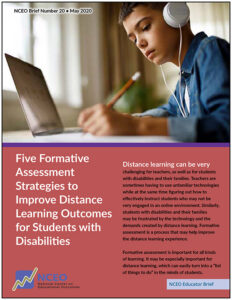
NCEO Brief 20

NCEO recently published Five Formative Assessment Strategies to Improve Distance Learning Outcomes for Students with Disabilities. This brief describes the use of formative assessment processes with students with disabilities during distance learning. Formative assessment is important for all kinds of learning, and especially focuses students on learning and evidence of learning.

read entire article


New TIES Center Distance Learning Series

TIES Center Distance Learning Series

A NCEO affiliated center, TIES Center, launched a distance-learning series that provides a framework for students with the most significant cognitive disabilities to get through these new transitions to distance learning, engage fully in academics online, and interact with their teachers and peers, a critical component of well-being.

read entire article


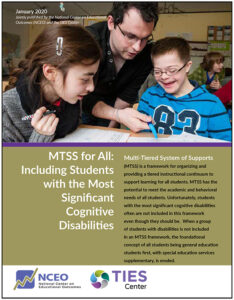
New Brief on Including Students with the Most Significant Cognitive Disabilities in Multi-Tiered System of Supports

Brief on MTSS

NCEO and an affiliated center, TIES Center, recently co-published MTSS for All: Including Students with the Most Significant Cognitive Disabilities. The brief provides suggestions for ways in which multi-tiered system of supports (MTSS) can include students with the most significant cognitive disabilities so that MTSS provides a whole school and whole district approach.

read entire article


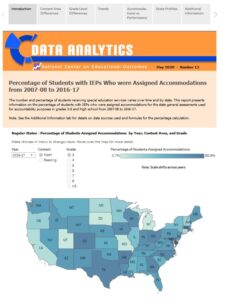
DataAnalytics13Three New Interactive Data Analytics Published

NCEO has published three new interactive Data Analytics reports. Two reports provide a way for users to visualize and understand trends in assessment participation and accommodations use for students with disabilities over time. The third report explores and summarizes states’ practices on publicly reporting assessment data for students with disabilities and English learners with disabilities.

read entire article


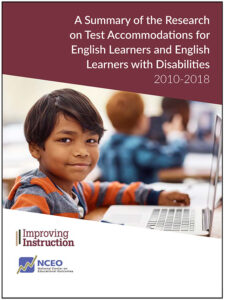
Research on Test Accommodations for English Learners and English Learners with Disabilities from 2010 to 2018

Summary of Research on Test Accommodations

An NCEO affiliated project, the Improving Instruction for English Learners Through Accessibility Decision Making project, recently published a comprehensive literature review titled A Summary of the Research on Test Accommodations for English Learners and English Learners with Disabilities: 2010-2018. In this review, the authors examine the purpose of each study, the type of assessment measured, the content area assessed, the type of linguistic support accommodation examined, the characteristics of the research sample and the participants, the type of research design, the findings, and author-identified limitations.

read entire article


Modules on Supporting English Language Learners Through Improved Accessibility Decision Making Launched

Supporting English Language Learners Through Improved Accessibility Decision Making module

An NCEO affiliated project, the Improving Instruction for English Learners Through Accessibility Decision Making project, recently released two online professional development modules on accessible instruction and assessment for K-12 English learners. One module is for elementary teachers and the other is for secondary teachers. The modules help teachers learn how to facilitate and document high-quality decision making about accessible instruction and assessment for English learners.

read entire article


NCEO’s National Assessment Center is supported through a Cooperative Agreement (#H326G160001) with the Research to Practice Division, Office of Special Education Programs, U.S. Department of Education. The Center is affiliated with the Institute on Community Integration at the College of Education and Human Development, University of Minnesota. The contents of this report were developed under the Cooperative Agreement from the U.S. Department of Education, but do not necessarily represent the policy or opinions of the U.S. Department of Education or Office within it. Readers should not assume endorsement by the federal government.
Project Officer: David Egnor

February 2020

Welcome

Welcome to the winter NCEO e-newsletter  I was honored to become the new director of NCEO last October when Martha Thurlow stepped down. I am very grateful for the support and encouragement that many of you provided during this transition.

I want to recognize the exceptional leadership that Martha provided NCEO over the years. Under her leadership, NCEO led the way in advocating for appropriate testing access, inclusion, and accommodations for students with disabilities, English learners, and English learners with disabilities. We are very fortunate that Martha will continue to be part of NCEO on a part-time basis in a retirement position.

Prior to assuming my current role, I was the associate director of NCEO. I look forward to building upon NCEO’s incredible history to support the continued growth and development of this forward-thinking organization. This will only be possible because of NCEO’s great staff and partners. Over the years, I’ve been inspired by the passion and energy of the wonderful team at NCEO who are dedicated to improving the instruction and assessment of students with disabilities, English learners, and English learners with disabilities.

In this issue, we highlight several NCEO resources that can be used to learn more about what the research says about the effectiveness of various accommodations. We also highlight several new publications, including a report on states’ alternate assessment based on alternate academic achievement standards (AA-AAAS) participation guidelines and definitions of students with the most significant cognitive disabilities. A brief on considerations for states providing materials in braille is also highlighted, as well as a parent-educator toolkit developed by an affiliated project, the Improving Instruction for English Learners Through Improved Accessibility Decisions project. Finally, in this issue, we provide information on NCEO presentations and posters at the annual conference of the Council for Exceptional Children (CEC).

The NCEO team and I love to hear from you. We welcome your ideas and suggestions for newsletter articles as we work to improve the instruction and assessment of all students, including students with disabilities, English learners, and English learners with disabilities.

Sheryl Lazarus, NCEO Director


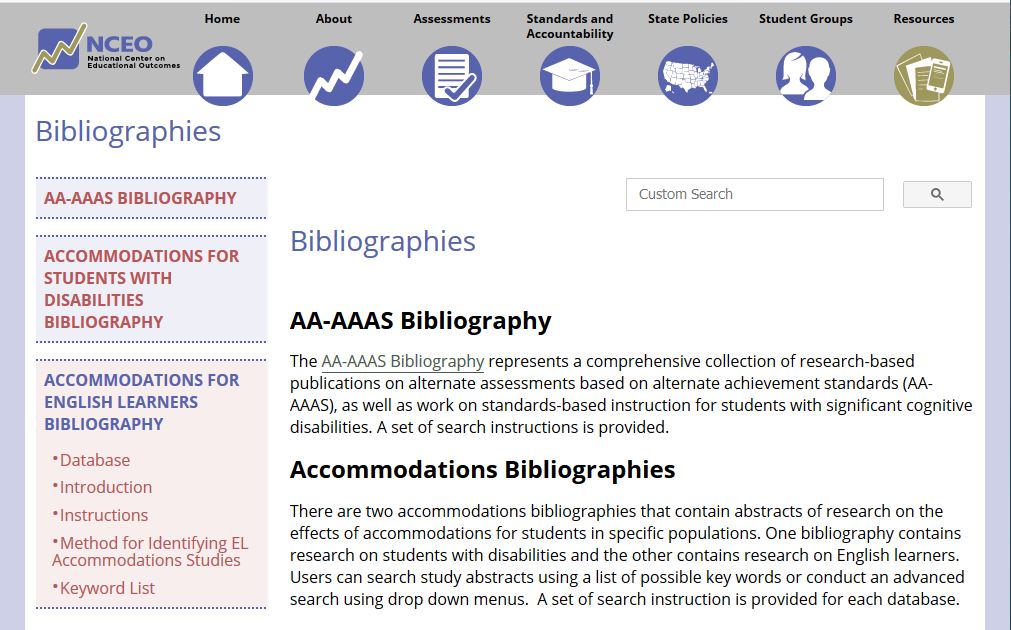
Accommodations Research Literature: Online Bibliographies and Research Summaries

NCEO Bibliographies webpageNCEO has several resources that can be used to learn more about what the research says about the effectiveness of various accommodations. These include online searchable databases, and published summaries of the research on effects of test accommodations that go back to 1999.

read entire article…


New NCEO Report on AA-AAAS Participation Guidelines and Definitions of Student with Significant Cognitive Disabilities

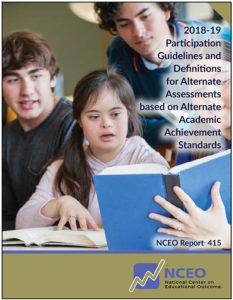
Cover of NCEO Report 415NCEO has released a report titled 2018-19 Participation Guidelines & Definitions for Alternate Assessments based on Alternate Academic Achievement Standards. This report provides an updated review of 2018-19 state criteria and guidelines for participation of students with the most significant cognitive disabilities in alternate assessments based on alternate academic achievement standards (AA-AAAS).

read entire article…


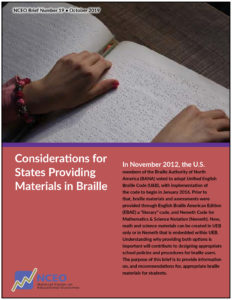
Brief 19 cover for WebNew Brief on Considerations for States Providing Materials in Braille

NCEO recently published, Considerations for States Providing Materials in Braille. This brief provides information on, and recommendations for, providing appropriate braille materials for students.

read entire article…


Improving Instruction Parent-Educator Toolkit

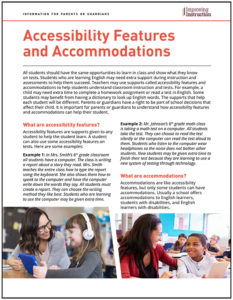
access brief parent thumbnailThe parents of English learners need to be involved in decisions about accessibility features for their children. An NCEO affiliated project, Improving Instruction for English Learners Through Improved Accessibility Decisions, recently developed a Parent-Educator Toolkit which contains a set of concise briefs for parents, teachers, and principals.

read entire article…


NCEO Presentations at Council for Exceptional Children Conference

CEC 2020 logoThe Council for Exceptional Children’s (CEC) annual conference will be held from February 5 through February 8, 2020, in Portland, Oregon. NCEO staff will be involved in several presentations and posters. We list here the conference presentations and posters by NCEO staff members.

read entire article…


NCEO’s National Assessment Center is supported through a Cooperative Agreement (#H326G160001) with the Research to Practice Division, Office of Special Education Programs, U.S. Department of Education. The Center is affiliated with the Institute on Community Integration at the College of Education and Human Development, University of Minnesota. The contents of this report were developed under the Cooperative Agreement from the U.S. Department of Education, but do not necessarily represent the policy or opinions of the U.S. Department of Education or Office within it. Readers should not assume endorsement by the federal government.
Project Officer: David Egnor

October 2019

Welcome

This newsletter includes articles on a variety of topics. First, a Brief on examining disproportionality is highlighted, including ideas for looking at data when sample sizes are small; this brief also provides a link to a video on producing confidence intervals. Following that is an article highlighting a study of guidance manuals; it describes ideas and lessons learned from leaders who developed state education agency and local education agency guidance manuals for identifying, assessing, and referring English learners (ELs) to special education. Presentations that will be made by NCEO staff in November in St. Paul, Minnesota (MELEd) and February in Portland Oregon (CEC) are also listed in this newsletter. Finally information on products from two NCEO affiliated projects is presented – first, several products from the TIES Center are shown, followed by a description of a module that is now publicly available from the DIAMOND project.

Sheryl Lazarus assumed the directorship of NCEO on October 1, 2019, so this will be the last time I write this “Welcome.”  For the next issue Sheryl will assume the “Welcome” note responsibilities, but I will still be part of NCEO and look forward to continuing to work with many of you as my role shifts.

– Martha Thurlow, NCEO Director

Examining Disproportionality of Student Group Participation in Alternate Assessments

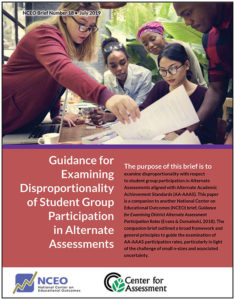
Cover of NCEO Brief 18The National Center on Educational Outcomes (NCEO) and the National Center for the Improvement of Educational Assessment (NCIEA) jointly published a Brief titled Guidance for Examining Disproportionality of Student Group Participation in Alternate Assessments. The purpose of this brief is to examine disproportionality with respect to student group participation in Alternate Assessments aligned with Alternate Academic Achievement Standards (AA-AAAS). It is a companion to the NCEO brief, Guidance for Examining District Alternate Assessment Participation Rates. This brief provides a more detailed examination and illustration of disproportionality.

read entire article…


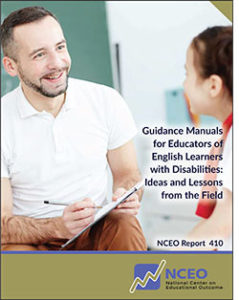
Guidance Manuals for Educators of English Learners with Disabilities: Ideas and Lessons from the Field

Cover of NCEO Report 410NCEO published a report, Guidance Manuals for Educators of English Learners with Disabilities: Ideas and Lessons from the Field (NCEO Report 410), written by Elizabeth Burr (WestEd). This report describes ideas and lessons learned from leaders who developed state education agency and local education agency guidance manuals for identifying, assessing, and referring English learners (ELs) to special education.

read entire article…


NCEO Presentations at MELEd and Council for Exceptional Children Conferences

NCEO staff will be involved in several presentations and posters at the 2019 MELEd Conference (MinneTESOL and the Minnesota Department of Education) from November 21 to November 23, 2019 in Saint Paul, MN as well as the Council for Exceptional Children’s (CEC) annual conference to be held from February 2 through February 8, 2020, in Portland, OR. See the article for the full lists.

read entire article…


New TIES Center Publications on Inclusive Education for Students with the Most Significant Cognitive Disabilities

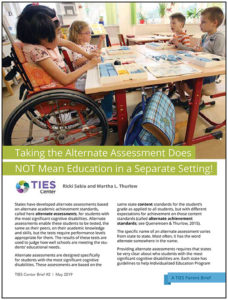
NCEO’s affiliated center, TIES Center, which is the national center on inclusive policies and practices for students with the most significant cognitive disabilities, has several new publications. See this article for more on Taking the Alternate Assessment Does NOT Mean Education in a Separate Setting! (TIES Center Brief #2), Using Systems Change Efforts to Implement and Sustain Inclusive Education Practices in General Education Settings for Students with the Most Significant Cognitive Disabilities: A Review of the Literature (TIES Center Report #102), and Communication Competence in the Inclusive Setting: A Review of the Literature (TIES Center Report #103).

read entire article…


DIAMOND Project’s “Making Accessibility Decisions for Everyone” Online Professional Development Course Launches

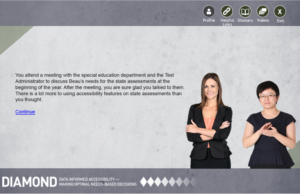
Thumbnail image for DIAMOND project courseNCEO’s affiliated project, the Data Informed Accessibility – Making Optimal Needs-based Decisions (DIAMOND) project, has released an online professional development module on accessibility features and accommodations, DIAMOND: Making Accessibility Decisions for Everyone. This professional development module is the culmination of the research work conducted by the DIAMOND project, and is designed to give educators the knowledge and tools they need to make, implement, and evaluate sound decisions about accessibility features for the students in their classrooms.

read entire article…


NCEO’s National Assessment Center is supported through a Cooperative Agreement (#H326G160001) with the Research to Practice Division, Office of Special Education Programs, U.S. Department of Education. The Center is affiliated with the Institute on Community Integration at the College of Education and Human Development, University of Minnesota. The contents of this report were developed under the Cooperative Agreement from the U.S. Department of Education, but do not necessarily represent the policy or opinions of the U.S. Department of Education or Office within it. Readers should not assume endorsement by the federal government.
Project Officer: David Egnor