Welcome
Fall is here, and the new academic year is well underway. In this issue, we share several new reports available from NCEO. One is a report on a forum held prior to the National Conference on Students Assessment to discuss text readers and their availability to all students on many assessments. Another report now available on the NCEO website presents the results of the 2016 survey of states. It provides a snapshot of the status of states related to topics, including many that have emerged since ESSA was enacted. Another report is a brief on making decisions about exiting English learner (EL) services for ELs with disabilities. All of these are highlighted in this issue, with links to the reports. NCEO also announces a new center on inclusive policies and procedures in this issue. The TIES center is being established with several partners to create sustainable changes in schools and districts that will enable students with significant cognitive disabilities to fully engage in the same instructional and non-instructional activities as their general education peers while being instructed in a way that meets individual learning needs. Finally, in this issue we look forward to two future activities. At the end of October, NCEO will attend the annual conference of the National Association of State Directors of Special Education to lead two discussion sessions known as YOU PICKS on the 1% cap and the alternate diploma. And, in November, NCEO will share information on using formative and interim assessments to improve student learning at the annual conference of the Teachers of Education Division of CEC. Look forward to lively discussions during these sessions!
– Martha Thurlow, NCEO Director
Forum Report on Text Readers for Everyone on All Tests
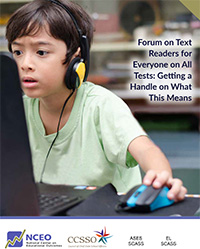 Text readers are now available in many states for all students. On June 27, 2017 NCEO, the Assessing Special Education Students (ASES) State Collaborative on Assessments and Student Standards (SCASS), and the English Learners (EL) SCASS held a joint forum on issues surrounding the use of text readers on tests. This a report on the discussions about availability of text readers for everyone on all tests, the differences in terminology for text readers, ways to develop common language around text readers, and challenges associated with text readers.
NCEO 2016 State Survey Report
 NCEO has published its 2016 state survey report, titled 2016 Survey of States: State Activities Amid Evolving Educational Policies. This report presents the results of the 15th survey of states by NCEO. The purpose of the report is to provide a snapshot of the new initiatives, trends, accomplishments, and emerging issues in states during a period of new education laws and initiatives.
Brief on Making English Learner (EL) Exit Decisions for ELs with Disabilities
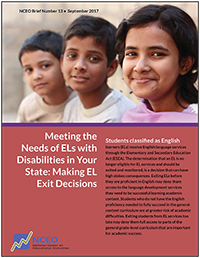 NCEO has published Meeting the Needs of ELs (English Learners) with Disabilities in Your State: Making EL Exit Decisions (NCEO Brief #13). This Brief summarizes key findings from a 2016 survey of Title III directors that asked about state policies and practices for exiting ELs with disabilities from EL services.
New Center Established on Inclusive Practices and Policies
NCEO has been awarded a $10 million grant from the U.S. Department of Education’s Office of Special Education Programs to establish a National Technical Assistance Center on Inclusive Practices and Policies. NCEO and its partners will establish the TIES Center (Increasing Time, Instructional Effectiveness, Engagement, and State Support for Inclusive Practices for Students with Significant Cognitive Disabilities).
The purpose of the TIES Center is to create sustainable changes in school and district educational systems so that students with significant cognitive disabilities can fully engage in the same instructional and non-instructional activities as their general education peers while being instructed in a way that meets individual learning needs.
NCEO at NASDSE for YOU PICKS
 NCEO staff members, Martha Thurlow and Sheryl Lazarus, will lead two YOU PICKS discussion sessions at the annual meeting of the National Association of State Directors of Special Education (NASDSE). YOU PICKS sessions are designed to be interactive sessions where states have the opportunity to reflect, share, question, and so forth.
TED CEC Conference Session on Using Formative and Interim Assessments to Improve Student Learning
 Please join NCEO’s Kathy Strunk for a session at the Teacher Education Division (TED), Council on Exceptional Children (CEC) Conference in Savannah, Georgia, titled Using Formative and Interim Assessments to Improve Student Learning. This session will be held on November 9 from 2:00 to 3:00 p.m.
NCEO’s National Assessment Center is supported through a Cooperative Agreement (#H326G160001) with the Research to Practice Division, Office of Special Education Programs, U.S. Department of Education. The Center is affiliated with the Institute on Community Integration at the College of Education and Human Development, University of Minnesota. The contents of this report were developed under the Cooperative Agreement from the U.S. Department of Education, but do not necessarily represent the policy or opinions of the U.S. Department of Education or Office within it. Readers should not assume endorsement by the federal government.
Project Officer: David Egnor
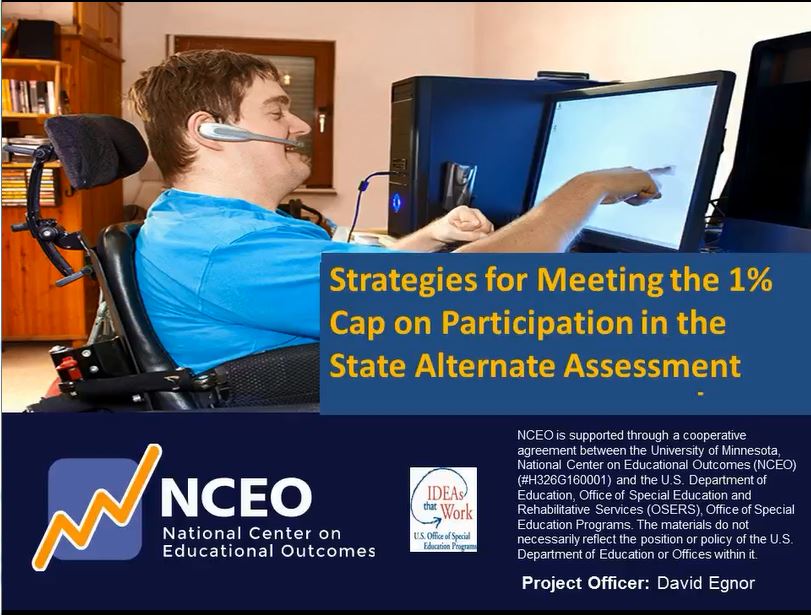 NCEO presented a webinar on April 27, 2017 on Strategies for Meeting the 1% Cap on Participation in the State Alternate Assessment, covering what the Every Student Succeeds Act (ESSA) says about the 1% cap on participation in the alternate assessment, the provisions in regulation for requesting a waiver from the 1% cap, and several strategies for meeting the 1% cap.
 NCEO and the National Technical Assistance Center on Transition (NTACT) hosted a webinar on state-defined alternate diplomas for students with the most significant cognitive disabilities.
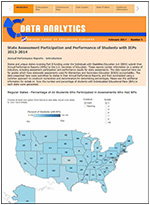 NCEO published the fifth Data Analytics report, State Assessment Participation and Performance of Students with IEPs, 2013-2014. The online interactive data report highlights the Annual Performance Report (APR) data for 2013-14 state-level assessment participation and performance results for students with IEPs.
 NCEO’s Sheryl Lazarus is the co-author of a resource, Formative Assessment for Students with Disabilities, that was recently published by the Council of Chief State School Officers (CCSSO). This report provides practical suggestions and information about how formative assessment can be used with all students, including students with disabilities.
 Please join NCEO, the ASES SCASS, and the EL SCASS for a pre-session on June 27 at the National Conference on Student Assessment in Austin, Texas titled Text Readers for Everyone on All Tests – Getting a Handle on What This Means. This pre-session will bring together states, assessment vendors, and other educational stakeholders to address the need to develop clarity on the implementation of text readers.
 The 2017 National Conference on Student Assessment (NCSA) is the premiere forum for assessment practitioners to discuss what is happening in the real world of educational assessment—what is new, what is going on at the state and federal level, what works, and what does not. NCEO staff members will participate in several sessions.
 To try to understand the diploma options available for students with disabilities, Achieve and NCEO partnered to analyze the diplomas available in each state for the graduating class of 2015. The report,
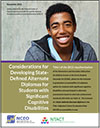 NCEO and the National Technical Assistance Center on Transition (NTACT) recently jointly published a Brief,
 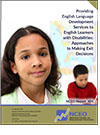 NCEO recently published a new report,
  In 2015, the National Center on Educational Outcomes and nine state partners (Minnesota, Alabama, Connecticut, Maryland, Michigan, Ohio, West Virginia, Wisconsin and the Virgin Islands) began a two-year Enhanced Assessment Grant project called “Data Informed Accessibility—Making Optimal Needs-Based Decisions (DIAMOND).” The DIAMOND project will improve the validity of state English language arts, mathematics, and English language proficiency (ELP) assessment results by developing decision-making guidelines for choosing accessibility features and accommodations for K-12 students. We present updates that include a new project website and presentations at upcoming conferences.
 NCEO has been awarded a five-year grant by the U.S. Department of Education, Office of Special Education Programs, to continue its work as a national technical assistance center. Starting October 1, 2016, NCEO’s knowledge development and technical assistance activities focus on increasing the participation and improving the results of students with disabilities on state and districtwide assessments.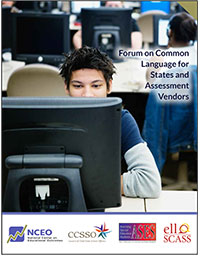
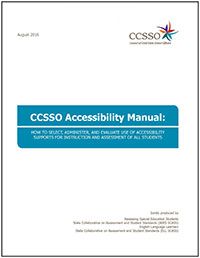 An accessibility manual was recently published by the Council of Chief State School Officers (CCSSO). It establishes guidelines for states to use for the selection, administration, and evaluation of accessibility supports for instruction and assessment of all students, including students with disabilities, English learners (ELs), ELs with disabilities, and students without an identified disability or EL status.
 NCEO recently published a new report on high school accommodations policies, 2015-16 High School Assessment Accommodations Policies: An Analysis of ACT, SAT, PARCC and Smarter Balanced. Many students with disabilities and ELs use accommodations to access the ACT, SAT, PARCC, and Smarter Balanced assessments. This report analyzes differences in the accessibility framework, decision-making process, and terminology across the four assessments.
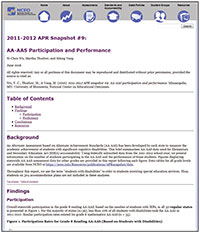 States annually report through an Annual Performance Report (APR) on their progress toward meeting the targets in their State Performance Plan (SPP). NCEO recently published several APR Snapshots that use 2013-14 APR data to look at how students with disabilities are included in assessments used for Elementary and Secondary Education Act (ESEA) accountability.
 NCEO recently launched its Facebook page. NCEO hopes that being on Facebook will Increase visibility of NCEO and its work, share with wider audiences its products, inform audiences on upcoming activities, and keep TA partners engaged with NCEO.
 Recent surveys of teachers found that students with disabilities like many of the features of the new college- and career-ready (CCR) assessments that were recently rolled out by states and consortia. Still, teachers identified assessment challenges that need to be addressed to improve student outcomes.
 NCEO released an updated version of its Principles report, one that recognizes a dramatically changing assessment landscape. The report, titled Principles and Characteristics of Inclusive Assessment Systems in a Changing Landscape, is an update of the 2008 Principles. It reflects the broader perspective that acknowledges that the Principles apply to English learners (ELs) and ELs with disabilities, as well as to students with disabilities. The principles also apply to all types of assessments, not just those used for accountability purposes.
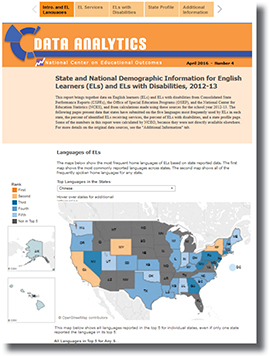 NCEO just published a new Data Analytics, State and National Demographic Information for English Learners (ELs) and ELs with Disabilities, 2012-13. There is wide variation across states in the most common home languages, and the percentage of ELs and ELs with disabilities.
 The 2016 National Conference on Student Assessment (NCSA) is the premiere forum for assessment practitioners to discuss what is happening in the real world of educational assessment—what is new, what is going on at the state and federal level, what works, and what does not. This year, the NCSA meeting will be held in Philadelphia, PA, on June 20-22, and NCEO staff members will participate in several sessions.